Prop Firm Trading Strategy That Guarantees Passing Funded Challenges and Consistent Payouts
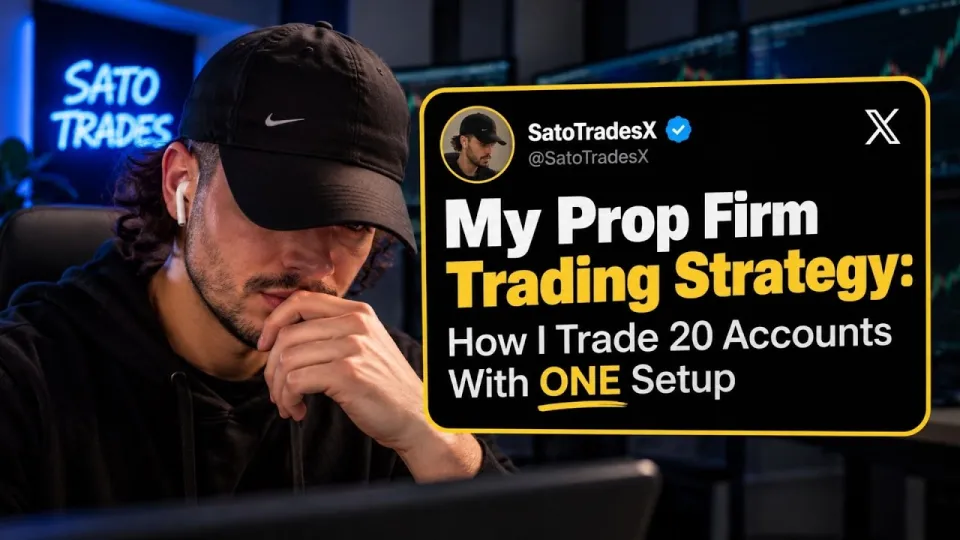
· based on the channel Sato Trades
A prop firm trading strategy that guarantees passing funded challenges relies on a precise mechanical system, disciplined risk management, and careful market structure analysis. This approach centers on futures trading, particularly the ES (E-mini S&P 500) and NQ (Nasdaq futures), using the 1-minute chart to find optimal entries and exits. By marking daily and intraday levels and combining them with confluence factors, traders can identify high-probability setups that meet prop firm evaluation criteria.
Core Elements of a Prop Firm Trading Strategy
The foundation of passing any prop firm challenge is a mechanical trading system that removes emotional biases and enforces discipline. This strategy uses:
- Daily ES & NQ Levels: These are premarket levels marked on TradingView that act as support and resistance zones.
- Intraday Potential Longs and Shorts: Levels derived from price action and order flow to pinpoint exact entry points.
- High-Timeframe Market Structure: Understanding when not to trade based on overall market trends and structure.
- Set and Forget Orders: Limit orders, stop losses, and take profits are placed in advance to manage risk effectively.
By following these core elements, traders can consistently meet the daily trading targets required by prop firms.
How to Mark and Use Levels Effectively
Marking levels accurately is crucial. Use TradingView tools to group and hide levels for cleaner charts. The daily levels come from key highs and lows of the ES and NQ futures contracts. Intraday levels are updated throughout the session based on order flow and volume spikes.
Trade entries occur when price approaches these levels with confirmation from:
- Price action signals (reversals, breakouts)
- Confluence with other technical indicators or market structure
Avoid trading when the market structure indicates a strong trend against your planned direction.
Risk Management Rules to Protect Your Funded Account
Risk management is non-negotiable in prop firm trading. Key rules include:
- Always use predefined stop losses to limit downside risk.
- Place take profit orders to secure gains and avoid emotional decisions.
- Risk only a small percentage of the account balance per trade, typically 1% or less.
- Use limit orders to enter trades at favorable prices.
This disciplined approach helps protect the funded account during volatile sessions and ensures compliance with prop firm rules.
Trading Multiple Accounts and Scaling Up
Scaling is a strategy to increase profits without increasing risk per account. This trader uses Tradovate combined with a trade copier service to manage 20 accounts simultaneously. The copier duplicates trades across accounts, allowing:
- Consistent execution
- Diversified risk across accounts
- Faster achievement of payout targets
Scaling requires strict adherence to the same mechanical rules across all accounts to maintain consistency and avoid overtrading.
Handling Trading Psychology in Prop Firm Challenges
Trading funded accounts introduces psychological stress. Mechanical systems help reduce emotional interference, but traders must also:
- Stick to the plan regardless of short-term outcomes
- Avoid revenge trading after losses
- Focus on process, not just results
This mindset shift is critical to passing evaluations and maintaining long-term profitability.
Useful Tips and Tools
- Use TradingView's grouping feature for level management
- Maintain a trading journal to track setups and outcomes
- Join supportive communities for daily levels and strategy discussions
Useful Links
- Get daily ES & NQ levels and tutorials in Sato VIP
- Best futures prop firms guide: https://satotrades.com/guides/best-futures-prop-firms
- Free Discord with daily levels and proof: https://discord.gg/Yt5PuQjXRp
- Trade copier service: https://portal.tradecopia.com/signup?via=SATO
Итог
A prop firm trading strategy that works in 2026 combines a mechanical system based on 1-minute futures charts, strict risk management, and proper market structure analysis. Using daily and intraday levels on ES and NQ futures, traders can identify consistent setups. Scaling through multiple accounts with trade copiers amplifies gains while managing risk effectively. This strategy, detailed by the Sato Trades channel, helps traders stop failing evaluations and start achieving reliable payouts. For ongoing support and daily levels, consider joining the Sato VIP program.
Key takeaways
- Uses mechanical trading system based on 1-minute futures charts
- Focuses on ES & NQ daily and intraday levels for entries
- Strict risk management: set stop loss and take profit orders before trading
- Trades multiple accounts using trade copier for scaling
- Avoids trading against market structure and uses confluence for higher accuracy
Questions & answers
What is the main chart timeframe used in this prop firm trading strategy?
The strategy focuses on the 1-minute chart for futures trading, specifically using ES and NQ contracts to find precise entry points.
How does risk management work in passing prop firm challenges?
Risk management involves setting stop losses and take profits before trading, risking a small percentage of the account per trade (usually 1% or less), and using limit orders to control entries and exits.
Can this strategy be scaled to multiple accounts?
Yes, the strategy supports scaling by trading multiple accounts simultaneously using a trade copier, which replicates trades across accounts to increase profits without increasing risk per account.
What tools help with marking levels and managing trades?
TradingView is used for marking daily and intraday levels with features like grouping and hiding levels. Additionally, trade copier services help manage multiple accounts efficiently.
Source: Prop Firm Trading Strategy: How to Pass a Funded Challenge in 2026 · Markdown version